Geekway 2024: Day 2

Today was my short day. We got a late start getting the girls to my parents’ and I had to get home early to pick them up and bring them home. Our group indulged me and played all my picks from the Play and Win room.

Pollen (2023)
2-4 players, 11+, 30-45 minutes

This beautiful nature-themed game (surprise, I have a type) is all about tile laying and area control. It’s pretty simple, really. Players “plant flowers,” “attract pollinators” and “pollinate flowers” for points by matching colors and pollinator symbols. The player who collects the most of two types of pollinators wins.

It’s a quick play that’s challenging enough to be entertaining, but still delightfully light. And those components! The wooden pollinator meeples are some of the most gorgeous game components I’ve come across in more than a decade of gaming. The foil details mimic the iridescence found on some real life beetles, and they’re really a joy to look at while collecting them throughout the game.

Trailblazer: The John Muir Trail (2023)
1-4 players, 14+, 30-120 minutes

Trailblazer was my favorite game of the day. In this worker placement/adventure game, players collect resources to move along the John Muir Trail and complete side quests along the way for victory points and other resources. As players progress down the trail, it becomes more difficult to move. Unpredictable weather tiles can also take its toll.

The theme is *chef’s kiss* – it makes the game play logical and easy to understand, which is good because there’s often a lot going on and the rulebook isn’t the best (check the rule clarification section for need-to-know info).

Lots of events tend to chain together on turns, making them oftentimes more eventful than “just buying a card” or “just collecting resources.” I really enjoyed that. Also, I know I sound like a broken record – but the game is just GORGEOUS.

Life in Reterra (2024)
2-4 players, 10+, +/-35 minutes

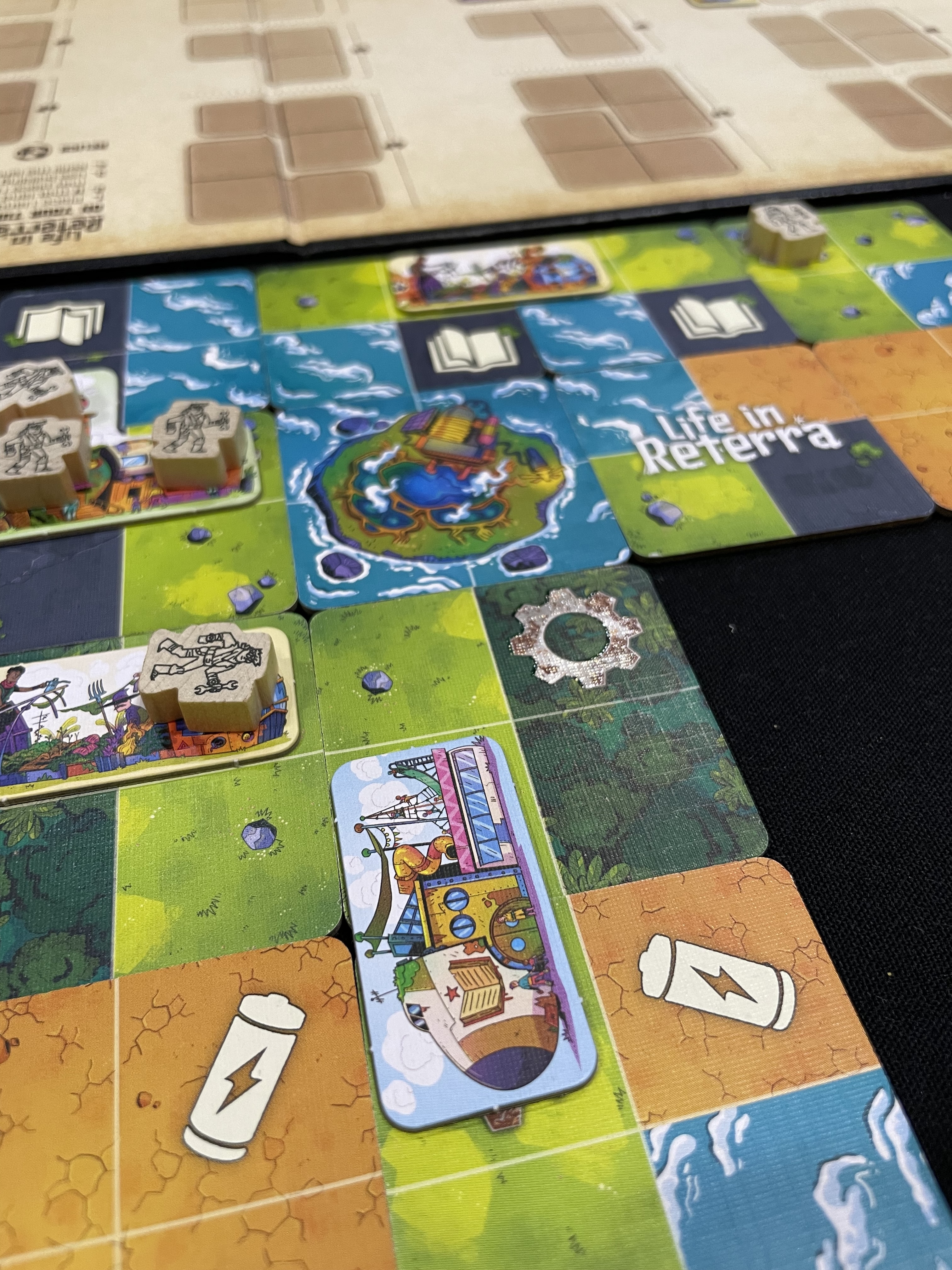
In this game, set far into the future, players work to rebuild their communities, which have become overgrown and reclaimed by nature. To do so, they lay tiles to create their own 4×4 grid “community.” Within that community, players raise buildings (each with a special power or function) and add inhabitants to maximize their score by the time all players have completed their grid.

The game itself is colorful and the art is amusing. The components are, blah. Nothing to write home about. It was easy to set up, and a quick play – we finished in about 35 minutes with three players.

Although I didn’t finish last (nor did I win), this was probably my least favorite of the day. Still, I’d play it again just to check out the other two ready-to-play building sets that come in the box.

Stay tuned for Day 3 tomorrow.

It’s my way or… Geekway

Today was Day 1 of 2024’s Geekway to the West, an annual board gaming convention in St. Louis. We’ve been going for more than a decade, and I still lose most of the games I play — but I find ways to have fun anyway. Here’s a rundown of today’s plays and my initial reactions to the games.

Faraway (2023)

This is a cute little adventure card came in which players explore a “mysterious continent” and battle to earn more “fame” than their opponents. To do that, they build a row of eight cards in front of them, left to right, then they move back through the path they created, collecting resources and scoring points on their cards.

There is a little bit of card drafting at play. A little wagering (when it comes to determining play order). The art on the cards is colorful and creative. The adventure theme is on point. It’s pretty light, which I tend to like.

I didn’t play well at all this first time. As soon as I started to understand all the mechanics, I realized I’d built my chain of cards in the wrong direction. Guess there’s always next time 😉

Junk Drawer (2023)

This is a short and sweet Tetris-like, tile-placing game that’s easy to learn and quick to play – even by yourself. It also really appealed to my love of (attempted) organization.

Players earn points by drawing and placing item tiles of different shapes on their player boards. The placement of the shapes in each section of the player board corresponds to a one (of a set of four) community goal cards ranging from easy to hard. In group play, the highest score wins.

I grabbed this from the “Play and Win” room and took it to a quiet spot in the convention center while I waited on hold for a telehealth appointment. I was able to teach myself fairly easily and play through at least once, but I didn’t keep score so I’m not even sure how I did.

I enjoyed the theme. The components aren’t anything amazing, but they’re solid. I know this would be fun with my kids, but it might not appeal to my usual gaming group. Still, I might see if they’ll indulge me sometime this weekend so I can see how it plays with others.

Harmonies (2024)

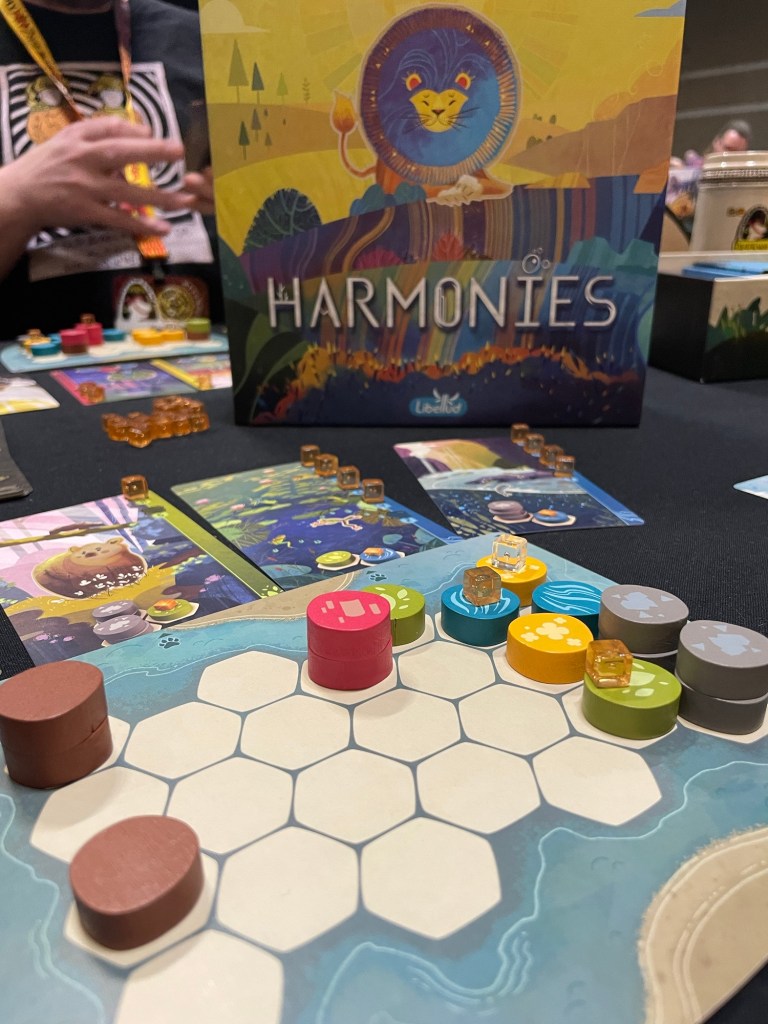
Harmonies is about landscape & animal habitat building, and I’m a sucker for nature games. Of today’s plays, I think this one was my favorite.

Players draft landscape tokens and play them on their board to create a habitat, then use tokens (resources) to play animals on their board for points.

The landscapes themselves were pretty and the components were nice as well. The token drafting reminded me of games like “Azul.”

As usual, I didn’t win – but I didn’t lose horribly, either. The theme was really immersive – everything from the way the resources functioned to how they scored points were logical and meaningful. I often find I understand games more easily when the theme is functional. It’s a huge pet peeve of mine when the theme is sloppily applied and not actually relevant to game play.

Apiary (2023)

It’s bees in space, basically. This worker placement game was definitely the heaviest of the day (but not the heaviest of this type of game I’ve played before).

Players move little worker bees representing their faction around a board to essentially build out a spaceship/colony that generates resources and scores points. It’s a machine-builder, and the different factions have their own superpowers/strengths. One player’s faction seemed to overpower the others today, and he totally creamed the rest of us.

Again, the theme was creative and immersive, but this time around there was too much going on for me to be effective on my first play through. I spent far too much time trying different actions around the board and never did settle into a strategy. I’d play this again, but it wasn’t my favorite today.

The Bears and the Bees (2018)

We closed out the day with this quick and easy nature game, which has some similarities with the card game Uno, in that you’re trying to be the first to play all your tiles. Players build out a hive around the Queen bee by matching colors on the side of the tiles.

The play is simple but fun. I actually won the two rounds we were able to play before we had to leave for the day.

Bonus points for how wholesome this game and its creators are. Each of Grandpa Beck’s Games comes with one of Grandma Beck’s recipes – this one a whole wheat pancake/waffle recipe. I might have to try it.

Definitely looking forward to playing this one with my girls. 🙂

Looking forward to day 2…

Starting a Horror Club at LC

Just before Springfest this year, I decided to cast out a net and see if I could find some students to start a new student organization for Fall 2024, with me as their advisor. Just like that, LC Scares was born.

I didn’t expect a lot of takers right away, but to my surprise, I was met with interest from a number of students who want to join – even some soon-to-be alumni who lamented that this wasn’t a thing before they were getting ready to graduate.

If you’re a student at Lewis and Clark Community College and want to get involved, email me about joining today!

‘The Great Upheaval’ Author Arthur Levine Addresses Colleges’ Role in the Knowledge Economy

Posted at lc.edu February 14, 2023

Article by: Laura Inlow, L&C Marketing and PR, linlow@lc.edu

GODFREY – In today’s knowledge economy, education providers must be nimble, innovative and ever-changing to meet the needs of 21st century learners and employers.

Lewis and Clark Community College is striving to meet its constituents where they are – and taking a hard look at its offerings, modes of delivery, and potential access barriers in order to do just that.

On Tuesday, Feb. 7, the college welcomed guest speaker and distinguished scholar of higher education Arthur Levine, co-author of “The Great Upheaval,” for a series of discussions with campus and community constituents about the future of higher education, and the future of Lewis and Clark.

“Team members, faculty, students and even community guests were engaged and inspired by Levine’s keen insights,” said L&C President Ken Trzaska, who learned of and met Levine previously through a new presidents’ program he attended at Harvard while president at Seward County Community College in Kansas.

The two reconnected at last year’s Higher Learning Commission meetings in Chicago.

“It is reassuring that the college is on the right track in a lot of ways, and we are energized to keep moving forward,” Trzaska said.

Levine’s book, which he co-wrote with Scott Van Pelt, looks at the future of higher education through past, present and future lenses – its transformation in the wake of the Industrial Revolution; how other industries, including movies, music and newspapers, have navigated the changing global economy and society’s increasing reliance on technology; and what colleges and universities can do to remain relevant and competitive providers of knowledge into the future.

Levine said the transformation happens in stages, beginning with criticism of the current model for higher education, followed by denial, then experimentation and the emergence of new models – that’s where higher education is today. In the wake of the Industrial Revolution, multiple models were born, including technical colleges, research universities and junior colleges (predecessors of today’s community colleges), among others. It’s not completely clear which models will prevail this time around, but Levine says L&C’s outlook is good.

“I’m here because I believe this institution could be one of those models,” Levine said.

“The Great Upheaval” has been an inspiration to many on campus and reads like a blueprint for some of the changes Lewis and Clark is putting into motion to ­better serve its students and the greater community.

Levine’s campus visit, made possible by funding from the L&C Foundation, was packed with opportunities for L&C leadership, team members, students and others in education to glean additional insights from Levine and become a part of the conversation.

Competency-Based Education (CBE)

One of the biggest pushes Lewis and Clark has made since Trzaska joined the team has been a deep investment in the future of Competency-Based Education, which focuses on skills learned rather than time spent learning those skills. This kind of outcomes-based education is the future of higher education in the knowledge economy, as opposed to the industrial-era focus on seat time, Levine said. 

The college currently offers a CBE pathway in Welding Technology, alongside the more traditional path, and is working to offer CBE pathways in additional programs, including Information Technology. General education CBE courses are in the works. Professor of Literature Jen Fuhler has become an early leader in this area, creating CBE courses in both English and literature. They’re not currently on the schedule, but will be soon, said Vice President of Academic Affairs Sue Czerwinski.

While CBE courses are currently priced the same as traditional courses, Lewis and Clark is working on a potential model for offering subscription-based pay for CBE to stay competitive with Massive Open Online Courses (MOOCs) like Coursera and Udemy, and with industry brand names like Microsoft and Google, who are offering micro-credentials that are typically faster and cheaper than traditional college degrees and certificates.

“They’re driving up competition and driving down prices,” Levine said.

Those entities aren’t bound by regulations from accreditors and financial aid, as Lewis and Clark and other higher education institutions are, but Czerwinski said the college is working through that barrier.

Blendflex & Hyflex Courses

Community colleges often tout their flexibility, but Levine said the hype doesn’t always match the reality. Lewis and Clark, on the other hand, is reworking its course modes to remove access barriers for students.

One effort in that area has been an ongoing investment in flexible course offerings like Blendflex and Hyflex, which allow students more control over when and how they attend courses. In large part, these offerings came about due to the COVID-19 pandemic, but are unlikely to go anywhere anytime soon.

“COVID wasn’t a disruption, it was an accelerator,” Levine said. “We can’t ever go back to the way it was.”

Blendflex courses add a virtual component, so students can attend lectures via Zoom or other collaborative learning tools, rather than in person. It also allows them to switch back and forth between course modes throughout the semester according to their needs and their schedule. Hyflex courses take flexibility a step further, adding an asynchronous online component, so students don’t have to attend class at specific times at all.

Currently, several degree and certificate programs can be completed entirely online or in these flexible course modes, including, but not limited to Accounting, Child Development, Criminal Justice, Management, Social Media Management and Paralegal.

Many of the courses in Graphic Design and Web Design and Development are offered in Hyflex mode, according to Assistant Professor and Coordinator Louise Jett. Currently, each course has two sections – an online asynchronous section and a Blendflex section (face-to-face + online synchronous). Students in the online section have access to video recordings from the Blendflex sections and can watch the lessons anytime. Online students can also join the Blendflex classes in person or on Zoom when they want, but they are not required to do so like the Blendflex students.

“Hyflex is really a game-changer, especially for working adults,” Jett said. “A lot of non-traditional students, especially, are working full-time jobs during the day, and some are parents. With an online asynchronous option, they can be students at night or whenever it makes sense for their lives.”

Levine’s advice for Lewis and Clark is to focus on the 5Cs: consumers, convenience, content, connections and cost.

The college is actively seeking out innovative ideas and incentivizing faculty through a Teaching and Engagement Model, or TEM. The model, introduced in 2022, includes release time for faculty to work on projects that increase access for students – which might include curriculum conversion to CBE, recruitment of non-traditional students, expansion of programs and/or increased program offerings. There are currently 8-10 faculty members participating in the pilot program this year.

“It’s an opportunity to try something different, something new, with some release time from teaching,” Czerwinski said. “But the common theme throughout everyone’s projects is about making our programs and offerings more accessible.”

Students’ tastes and needs are changing, and the college must change with them. More and more are looking for cheaper, faster paths to a good career; anytime/anyplace, 24-hour access to professors, support and content; individualization; and lots of choices. Whereas today’s degrees are oftentimes “just-in-case” education, tomorrow’s focus will be on “just-in-time” education, Levine said.

The consumers themselves are changing as well. Though higher education will continue to cater to traditional students right out of high school, a pool of potential students for this new type of education includes first generation college students, working adults, parents, and others who may not see themselves as “college material.”

“Some don’t know what we do, or they just can’t see themselves here,” Levine said. “Some have jobs, some have families – there are a gazillion reasons why not. We have to tell them why.”

Lifelong learning is another big focus. Because of today’s shorter half-life of knowledge and technology, students may be in and out the door more quickly, but they are also more likely to continue coming back for additional reskilling and upskilling over the course of their lifetimes, Levine said. 

Levine suggested that Lewis and Clark must be inextricably intertwined with its community in order to continue distinguishing itself from the crowd. That’s one big focus of the college’s current strategic plan, with Key Direction 4 looking to broaden community and educational collaboration throughout the district and region.

“Levine’s visit was incredibly inspiring,” Czerwinski said. “There’s a transformation underway and we really believe that Lewis and Clark is poised to be a leader in shaping what education at a community college looks like in the next decade.

Coming to Terms with Adult ADHD

Over the past year and a half, while the world has been falling apart around us, I’ve been falling apart personally. Well, I guess that’s only true of one of the two new major health diagnoses I’m dealing with. The other one has been plaguing me all my life – I just didn’t realize it until now.

I have ADHD.

TLDR; my story is outlined below for two reasons:
1. To fight mental health stigma.
2. Compulsive oversharing can be a characteristic of ADHD (and mostly, it’s who I am.)

If you read no further, please check out this article on Adult ADHD as well as this self-reporting tool – particularly If you’re a Gen-X or Millennial female who is living in a constant state of overwhelm; who never seems to be able to keep up no matter how hard she tries; whose memory fails her often; and who feels like she could really use some help.

If you think you may fit the criteria, please speak with your doctor or call a place like Centerstone at (618) 462-2331 to speak with someone. I AM NOT A MEDICAL PROFESSIONAL. This is my personal experience.

The Road So Far

If you’re on TikTok, you know how that algorithm just gets you. One by one, adults living with ADHD started crossing my FYP (For You Page) earlier in the year, and it felt like each one was speaking directly to me and my experiences. They weren’t the stereotypical male children with hyperactivity we thought ADHDers were in the 90s. Turns out, more adult women are being diagnosed with the disorder these days, right around my age, right when the pressures of life have become so overwhelming, it’s hard to continue “passing” like they’ve learned to all their lives. Turns out, a lot of them have the “inattentive type,” and won’t present with much hyperactivity at all.

For the most part, that’s me.

This ADHD creator was one of the first I came across, and her content really spoke to me.

Go read Dani Donovan’s story at https://www.additudemag.com/illustrating-adhd-artist-story/ and see more of her awesome graphics at https://www.adhddd.com/.

I was a good student. I made good grades. I never got in trouble, other than for chatting too much with friends. As I climbed grade levels, sustaining my attention in class became more and more difficult. I didn’t process lectures the same way other kids did because I couldn’t retain the information just by hearing it. Instead of being disruptive, I quietly filled notebooks full of doodles and notes to friends or I slept. Then I would take home every book in my backpack and catch up on the work of the day, on my own time. I was an awful test taker – my memory has always been HORRENDOUS – but I worked long and hard to submit assignments to make up for that, and it earned me good final grades.

In college, procrastination and overnighters became the norm. I taught myself to test better by taking extensive notes, writing and re-writing study guides. I learned I could remember things more easily by tapping into kinetic memory – through the act of writing. But more than anything, I learned I could learn better by doing, and in the newsroom I thrived.

I followed that high right into the field of journalism and then into PR, where no two days are exactly the same and every day is interesting. Longer term projects remained a bit of a struggle because they couldn’t sustain my attention effectively, but I learned to manage my time through extensive scheduling, both electronic and on paper.

Then I got married and we became homeowners, pet owners and parents. Then my oldest kid started school in the middle of a historic pandemic.

Everything had come to a head. I knew I needed help.

After my mom got COVID in November and I got quarantined with the girls over my 36th birthday, I saw my doctor about depression. I started getting treatment for that and began to feel better, but I suspected my issue might be something more. Treatment was taking the edge off and tempering my external reactions, but it wasn’t doing anything to address the stimuli causing my reactions in the first place. The overwhelm was still there. No matter how badly I wanted to clean my house, there were still doom piles everywhere, waiting to be sorted. No matter how badly I wanted to be there for my kids, I was so tapped out after a day of working that I needed to veg out in complete silence, or drown myself in mindless TikToks, just to get back to feeling human again. (Depression and anxiety are often comorbid with ADHD, btw).

This past month, a mental health practitioner with Centerstone heard me out and validated my concerns, which was life changing in itself. On top of that, I started treatment July 15, and my life is finally starting to feel like it’s getting back on track.

ADHD still comes with a stigma, and so does its treatment (amphetamine stimulants are often the first course of treatment). I hope that is changing, and that’s why I’m sharing my story.

We are not lazy, or unintelligent, or less than. We have our ups and downs. Our brains work a little differently, which sometimes can go against the grain and cause us to struggle. Sometimes we can thrive. But there should never be any shame in asking for help when something doesn’t feel right.

Student Art Exhibition

Lewis and Clark Community College’s 16th Annual Student Art Exhibition launched last Friday, and three of my pieces were accepted into the juried show. I didn’t win any prizes, but as my first time being a part of an artist’s exhibition, I am so proud to have my work represented.

Look Beyond
“Look Beyond,” Laura Inlow, Expired Lomography Film, 8×10”
Hair
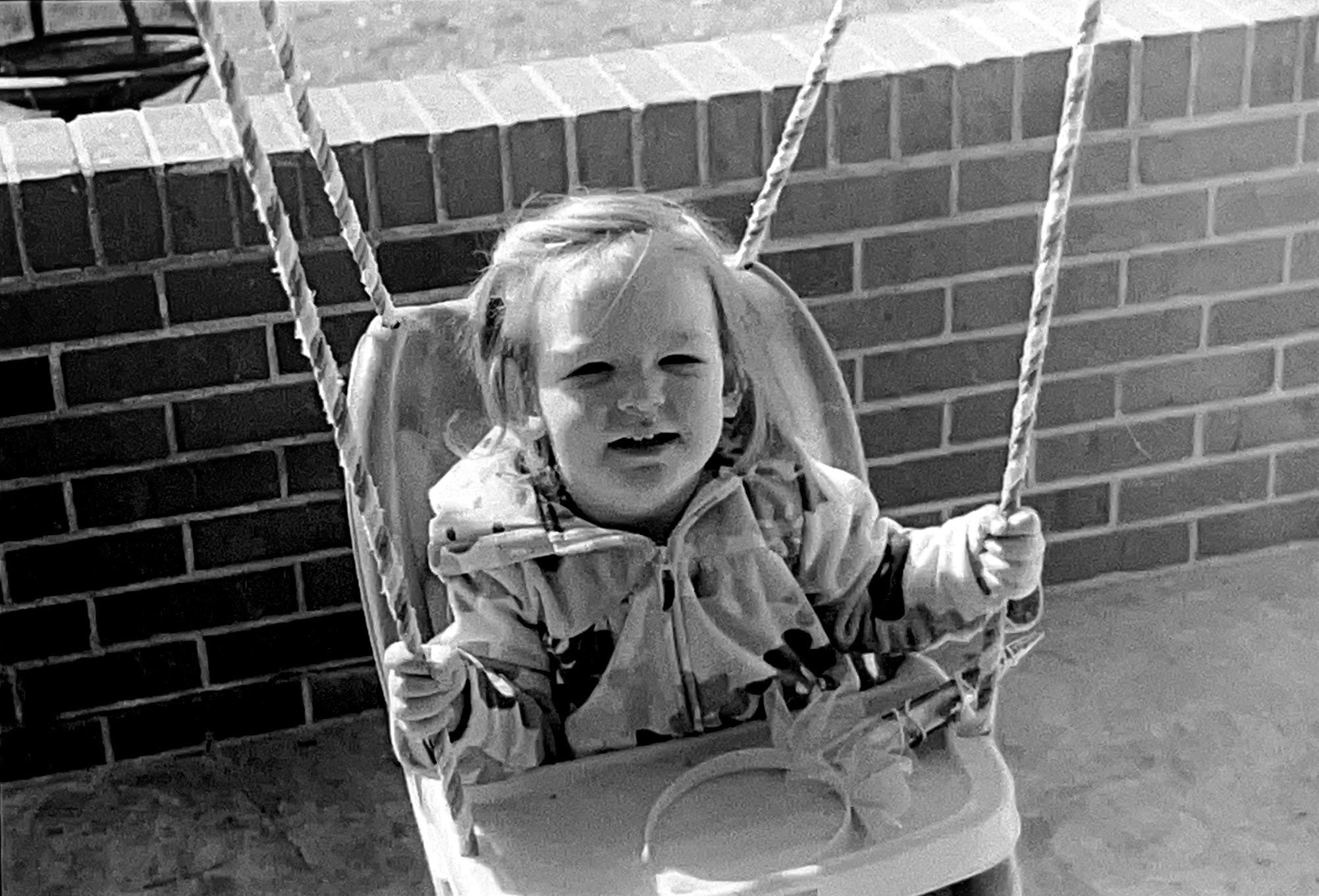
“Hair,” Laura Inlow, Gelatin Silver Print, Satin Finish, 8×10”
Golden Hour
“Golden Hour,” Laura Inlow, Expired Film, Halo-Chrome, Gelatin Silver Print, 8×10”

Check out the entire show at www.lc.edu/art-student.

Alton City Cemetery Pt. 1: Elijah P. Lovejoy

I grew up hearing about Elijah P. Lovejoy. I guess that’s because I’m from the Riverbend area.

When I got to journalism school at Eastern Illinois University, I was astounded that no one had heard of him. I get that the average Chicagoan was unlikely to know a lot about the town of Alton, but surely they had heard of this abolitionist, who was, after all, a journalist like themselves. Not so much, apparently.

We were on an Opinion Writing field trip to the St. Louis Post-Dispatch in 2005/2006 when I took several friends on a detour on our way back to Charleston, Illinois. We sat in Robert Wadlow’s chair and visited the Lovejoy Monument, as I had done many times before. But I’d never wandered into the Alton City Cemetery, though, until just recently.

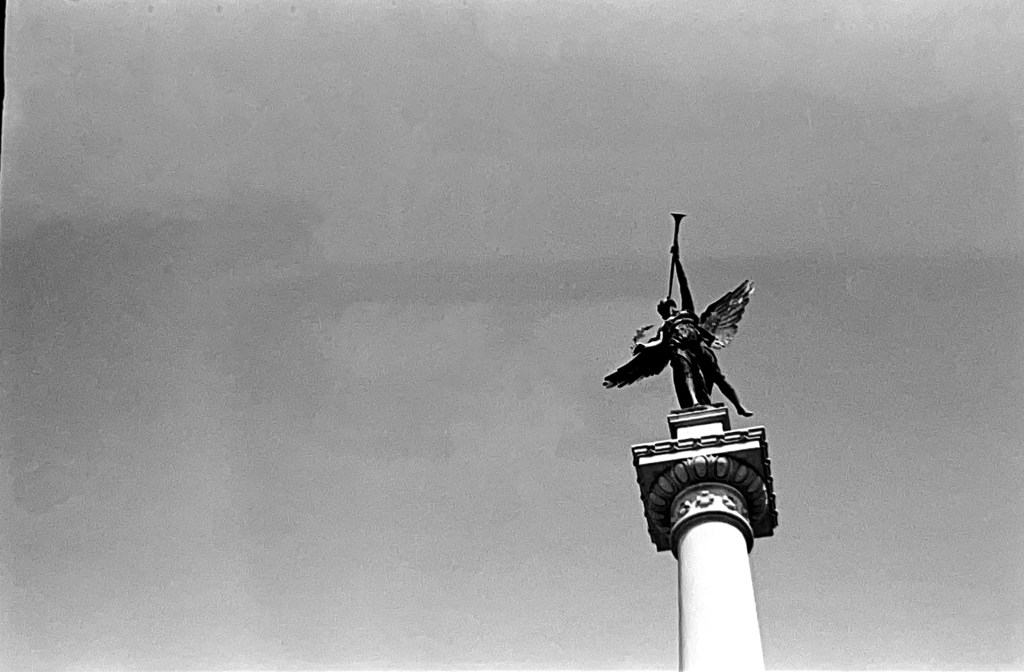
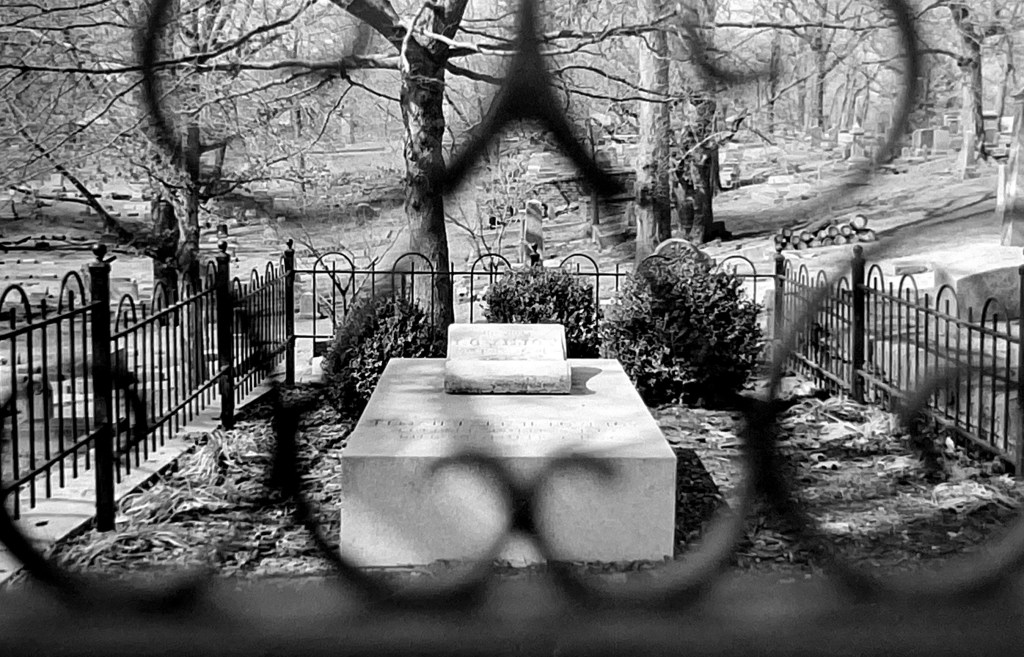
I started at the 110-foot monument, designed by architect R. P. Bringhurst. It was erected in 1897 to honor the memory of Lovejoy, who was the editor of The Alton Observer until his death in 1837, a day before his 35th birthday. Carved near the statue, a quote,

 “I have sworn eternal opposition to slavery, and by the blessing of God, I will never go back.

(Inscription on the Lovejoy Monument in Alton City Cemetery)

Before his death, pro-slavery advocates made a number of attacks on his printing press, trying to quiet the voice of the American abolitionist. Lovejoy was eventually shot and killed by a pro-slavery mob during one of those attacks. According to Wikipedia, he was originally buried in an unmarked grave until 1860, when local newspaper editor Thomas Dimmock located the grave and arranged for a proper marker. Some of his supporters are allegedly buried near him.

This March, I visited his actual gravesite for the first time, and photographed it for my film photography course. There was something special about being there. Today, Lovejoy is considered a martyr for the abolition movement and his gravesite is sacred, especially to a journalist like myself. Even though I no longer work in the field, it was an honor to stand there and reflect on my journey as well as the state of the world today.

Lovejoy’s impact is still a part of the Riverbend. The Telegraph, in Alton, where I worked as a reporter, page designer and web editor for three years right out of college, still bears the image of Lovejoy’s monument on its masthead. A local elementary school is named after him. The library where I studied at Southern Illinois University Edwardsville bears his name as well.

Still, the battle for racial and social justice is an uphill climb and a continuing battle in this community and beyond.

Spring is Coming

One year ago today – not to the date, but to the day – on the Friday before Spring Break, college leaders met around a huge table in the Foundation Board room and discussed the threat of COVID-19. We would extend spring break by a week, long enough to allow faculty some time to revert their courses to a virtual format. We prepared to hunker down for a month or two, or possibly longer.

Well, we all know how that turned out. Exactly one year later, our community’s positivity metric has finally dipped below, and stayed below 5% for weeks, and there are three vaccines being deployed across the U.S. My dad gets his second Moderna shot on Monday. Mom and I will get our second Pfizer shot in about a week. My husband had the Johnson & Johnson shot, so one and done. And Amelia starts school five days a week on Monday.

The college is preparing to begin reopening, and it’s likely I’ll be back on campus this summer… definitely by August. This thing isn’t over yet, but the end feels like it might finally be in sight. And that’s good, because I’m exhausted. This year, I’m taking spring break off work. I’m going to spend 8 days with my kids and one in the darkroom.

As I settle in tonight to begin said vacation, I can hear the insects and other wildlife singing outside. Time “springs forward” tomorrow night. Spring is almost officially here.

Finding My Inner Artist

“I am good at a lot of things, but great at very few.” That’s what the voice inside my head always tells me. When it comes to my art, especially, I have a serious case of imposter syndrome. “I’m not good enough.” “Other people can do it better.” “It doesn’t speak to anyone but me.” “People who say they like it are just trying to please me.” “Why don’t more people like it?” The self-doubt runs rampant.

Yet, I feel the need to create. I’m a good writer, but I don’t have the attention span to maintain interest in a story long enough to write a novel. I love to paint and draw, but – and I’m not being self deprecating here, just honest – I don’t know what the heck I am doing with a paintbrush or a pencil. I am not tone deaf and have a pretty good ear for music, but my voice cannot carry a tune to match and I never successfully stuck with learning an instrument.

My one constant has been my love of photos. Nothing lasts forever, you see, except a photograph. It started with home photos, snapshots and selfies throughout my formative years – a way to remember the moments and the people who helped make me who I am today. I never took much stock in the quality of the photos or the process of creating them, but I documented everything so I would have it forever.

In college, I took the requisite visual communication classes for my journalism degree, and held my first DSLR in the student newsroom. I admired my friends on the photo staff and marveled at the way they portrayed the things that were happening around us. When I graduated, photography became a component of my job – but it was less about the process and more about the subject of the photos that went with the stories I wrote as a local journalist.

A photographer friend and mentor of mine used to tell me I had a good eye, and ever since then, I’ve worked to improve my camera skills so I could make the pictures I see in my head of the beauty in ordinary things and in the people I love that make my life worth living. I’m still learning, and I always will be.

After the crazy year that was 2020, I needed an outlet. In January 2021, I began taking a film photography class at Lewis and Clark Community College, and I fell in love. The hands-on process of taking a photo without the crutch of the digital screen, and the tactile process of developing the film, then enlarging, printing and perfecting the photos in the darkroom, fed a part of my soul that has been starving for a long time.

I can’t wait to keep creating.